Introduction
In the post-training stage of large language models, reinforcement learning (RLHF / RLAIF) has become one of the key factors that determines the upper bound of model capability. Recently, GLM-5.2 switched its training algorithm from the GRPO (Generalized Reward Policy Optimization) used in GLM-5.1 to the more classical PPO (Proximal Policy Optimization), bringing a clear improvement in results.
This change is not a simple “algorithm replacement”. It is a systematic upgrade in stability, generalization, and training controllability.
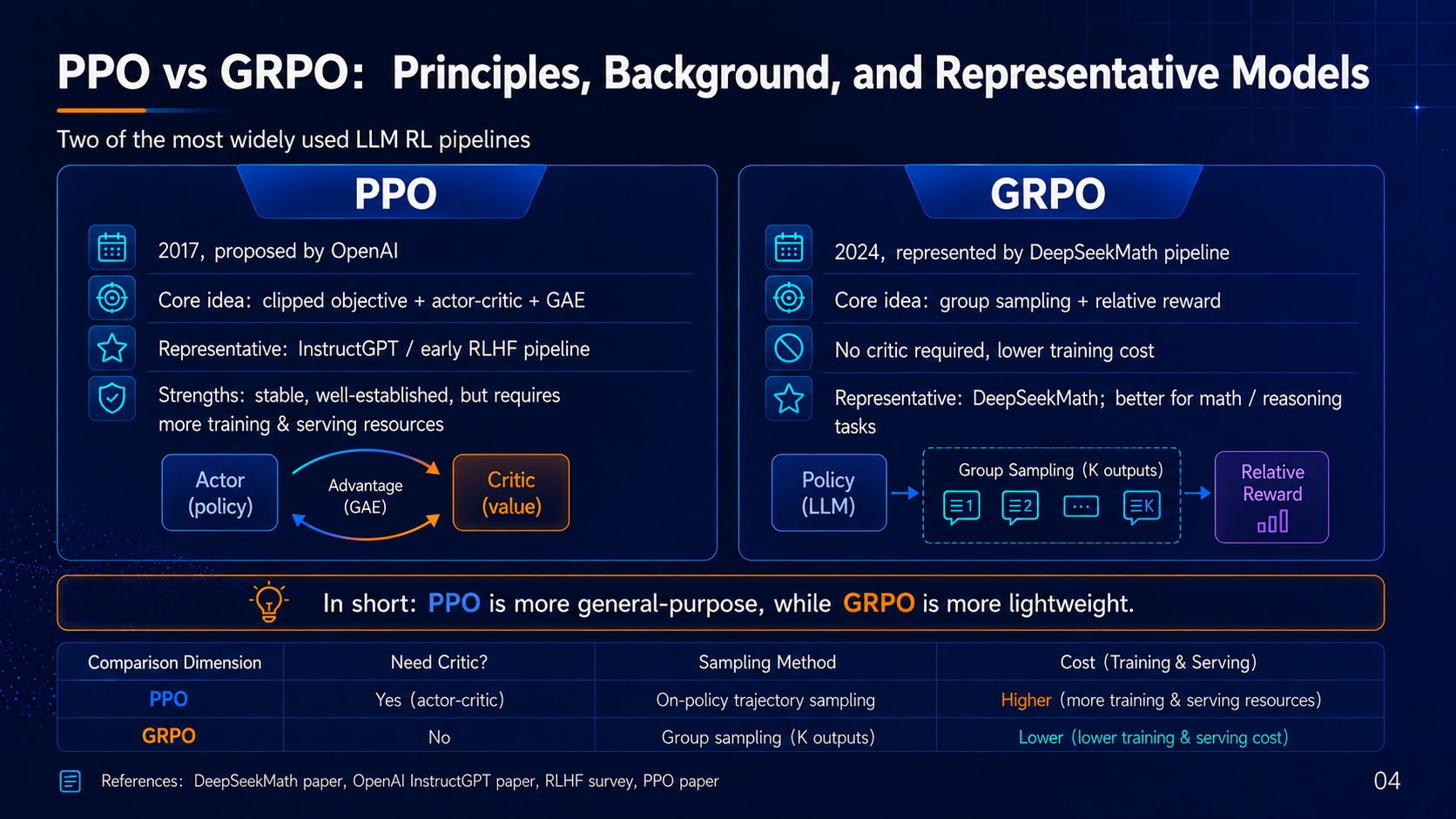
This article analyzes the topic from three angles:
- The core principles of PPO and GRPO
- The key differences between the two algorithms
- Why PPO can bring a “qualitative improvement”
How PPO (Proximal Policy Optimization) Works
1. Background
PPO is a policy gradient method proposed by OpenAI in 2017. It is an engineering-friendly simplification of TRPO (Trust Region Policy Optimization), and it has become the de facto standard in RLHF training.
2. Core Idea
The core goal of PPO is:
While optimizing the policy, limit the shift between the new and old policies to prevent unstable training.
Its optimization objective is:
$$ L^{PPO}(\theta) = \mathbb{E}\left[\min\left(r_t(\theta) A_t,\ \text{clip}(r_t(\theta), 1-\epsilon, 1+\epsilon) A_t\right)\right] $$
Where:
- $r_t(\theta) = \frac{\pi_\theta(a|s)}{\pi_{\theta_{old}}(a|s)}$
- $A_t$: advantage function
- $\epsilon$: clipping coefficient, usually 0.1 to 0.2
3. Key Mechanisms
PPO’s stability comes from three mechanisms:
Clipping
Limits the size of policy updates and prevents over-optimization.
Advantage Estimation (GAE)
Reduces variance and improves training stability.
Multi-Epoch Updates
Optimizes multiple times on the same batch of data, improving sample efficiency.
4. Role in Large Language Models
In LLM training, PPO is commonly used for:
- Aligning with human preferences (RLHF)
- Controlling generation style, including safety, format, and reasoning behavior
- Balancing exploration and exploitation
How GRPO (Generalized Reward Policy Optimization) Works
1. Background
GRPO is an optimization method proposed for RLHF scenarios that removes the value function, meaning it does not use a critic. Its goal is:
Simplify the PPO training pipeline, reduce engineering complexity, and improve throughput.
2. Core Idea
The key idea behind GRPO is:
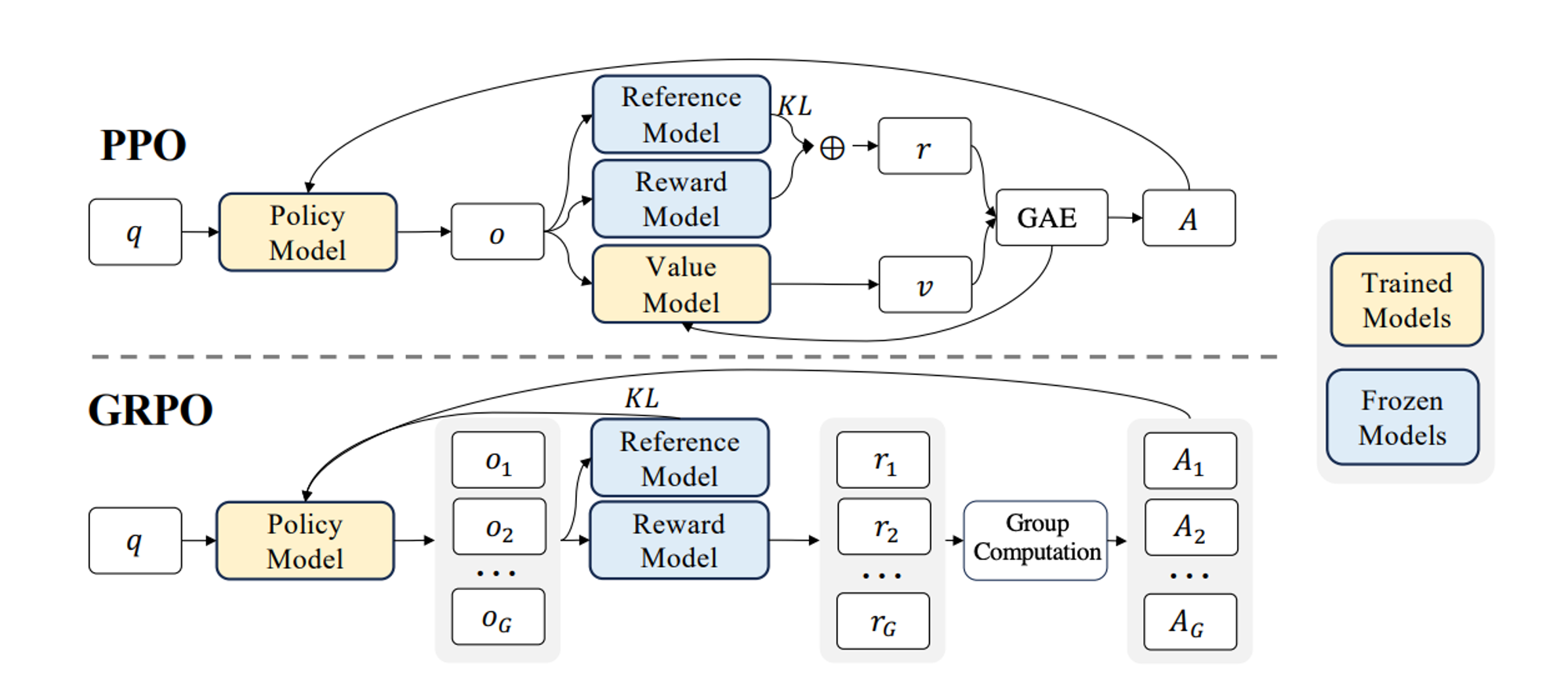
- Do not train a value model
- Do not compute advantages, or use a simplified substitute
- Directly perform relative optimization based on rewards
A typical workflow is:
- Sample multiple outputs for the same prompt, using N samples
- Score them with a reward model
- Normalize or rank the scores
- Update the policy using relative rewards
It can be represented as:
$$ L^{GRPO} = \mathbb{E}\left[\log \pi_\theta(a|s) \cdot \hat{R}(a)\right] $$
Where:
- $\hat{R}(a)$: normalized reward, such as rank-based or mean-centered reward
3. Key Characteristics
No Critic Architecture
Avoids the instability of value model training.
In-Batch Contrastive Learning
Relies on the relative quality of multiple samples under the same prompt.
High Throughput
Better suited for large-scale parallel training, especially multi-GPU inference sampling.
PPO vs GRPO: Key Differences
| Dimension | PPO | GRPO |
|---|---|---|
| Uses a value model | Yes | No |
| Advantage calculation | GAE | None, or simplified |
| Stability | 5/5 | 3/5 |
| Training complexity | High | Low |
| Sample efficiency | High | Medium |
| Parallelization friendliness | Medium | High |
| Dependence on reward quality | Medium | High |
| Sensitivity to data quality | Medium | High |
Why Did GLM-5.2 Switch from GRPO to PPO?
This is the core question of the article.
1. The Bottlenecks of GRPO
Although GRPO is simpler from an engineering perspective, it has several key issues.
Amplification of Reward Noise
GRPO strongly depends on the relative ranking of rewards. When:
- The reward model is not accurate enough
- The differences among multiple samples are small
It can lead to:
Extremely unstable gradient signals
Lack of Long-Term Credit Assignment
GRPO does not have a value function:
- It cannot model long-term returns
- It is less friendly to long-chain reasoning, such as CoT
Training Is Prone to Collapse
In some cases:
- The model overfits the reward model
- Outputs become patterned, leading to mode collapse
2. How PPO’s Advantages Show Up in GLM-5.2
A More Stable Optimization Path
PPO’s clipping and advantage estimation:
- Avoid policy oscillation
- Ensure gradual improvement, or monotonic improvement
Better Reasoning Capability
PPO’s value function:
- Can implicitly model intermediate steps
- Is better suited for chain-of-thought and multi-step reasoning
Lower Dependence on the Reward Model
Compared with GRPO:
- PPO does not rely entirely on reward ranking
- PPO is more robust to reward noise
Stronger Generalization
At its core, PPO optimizes:
A policy distribution, not a sample ranking
As a result, it is more stable in scenarios such as:
- Unseen tasks
- Long-form generation
- Tool calling
An Intuitive Analogy: Ranking vs Regression
An analogy can make the difference easier to understand:
GRPO is like ranking learning
- Which answer is better?
- It strongly depends on pairwise or listwise comparisons
PPO is like regression optimization
- How far is the current policy from the optimal policy?
- It has a continuous optimization direction
The conclusion is:
GRPO is faster. PPO is more stable and more precise.
Summary
The switch from GRPO to PPO in GLM-5.2 is essentially a shift:
From engineering efficiency first to model capability first
Key Takeaways
GRPO is suitable for:
- Fast training
- Large-scale parallelism
- Tasks with clear rewards
PPO is better suited for:
- High-quality alignment
- Complex reasoning tasks
- Long-context generation
At the current stage of LLM development:
Stability, generalization, and reasoning capability matter more than training throughput
Therefore, the return to PPO has become an almost inevitable choice.
Closing Thoughts
The choice of reinforcement learning algorithm is becoming a key dividing line in model capability. The shift from GRPO to PPO is not only an algorithm switch. It also shows that large model training is moving:
From “it can run” to “it can run well and run stably.”
In the future, we are likely to see:
- Hybrid PPO + DPO paradigms
- New off-policy RL methods
- Even reward-free alignment
But at the current stage:
PPO remains the most robust industrial-grade choice.