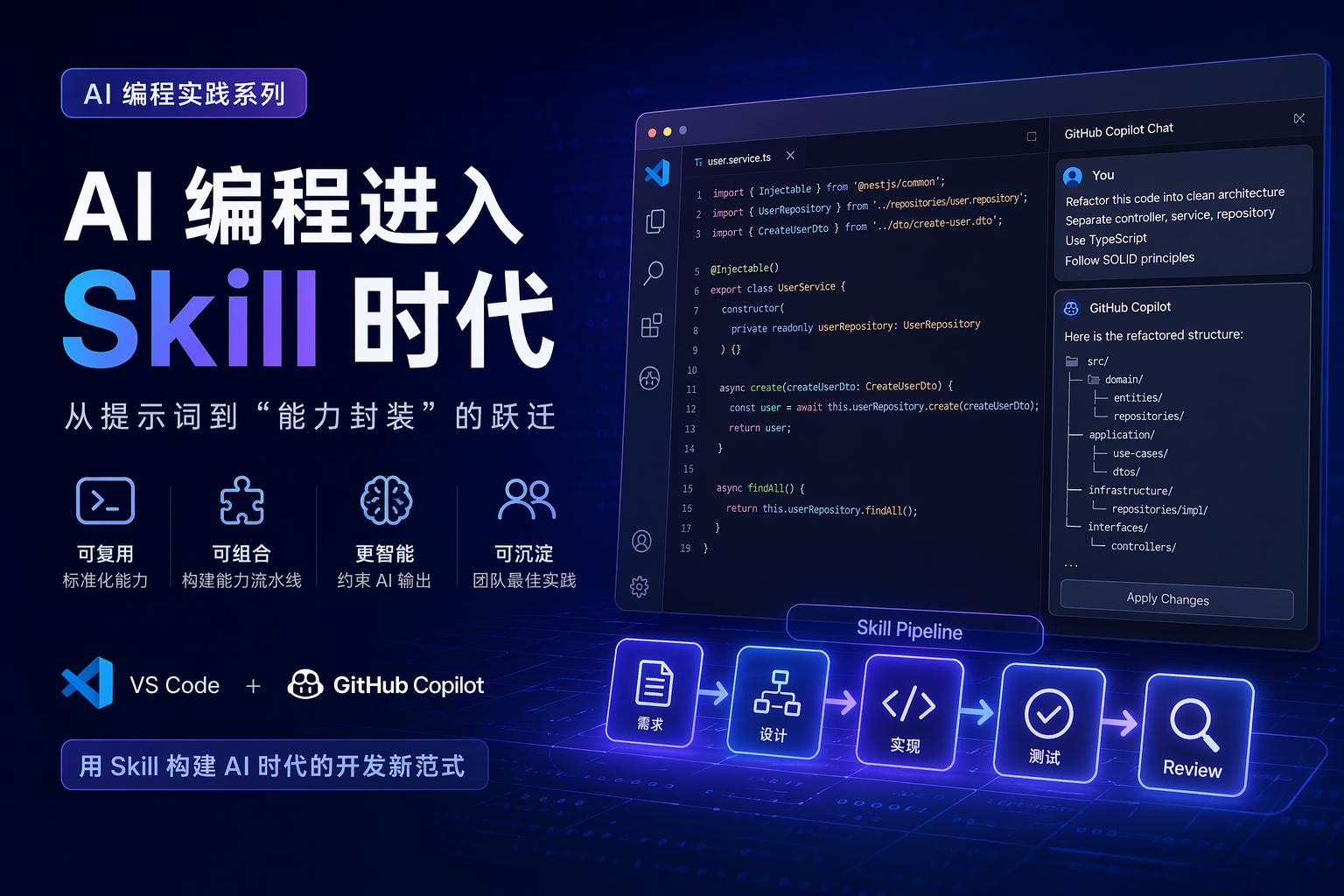
Over the past year, the mainstream way developers interact with AI for programming has gone through a clear evolution:
Prompt -> Prompt Engineering -> Context Engineering -> Skill (Capability Packaging)
If a prompt is a one-off invocation of model capability, then a Skill is essentially a reusable intelligent capability module. It enables AI to evolve from “answering questions” to “executing tasks.”
This article will systematically explain:
- What a Skill means in the context of AI programming
- The fundamental difference between a Skill and a prompt
- How to apply Skill thinking in VS Code + GitHub Copilot Chat
- Real engineering-level examples
What Is a Skill?
In the context of AI programming, Skill = structured prompt + context + execution constraints + output format.
A more engineering-oriented definition would be:
Skill = f(Instruction, Context, Constraints, Output Schema)
It is not just a single prompt. It is a reusable capability interface.
A Simple Comparison
| Approach | Characteristic | Problem |
|---|---|---|
| Prompt | Ad hoc input | Not reusable, not stable |
| Prompt Engineering | Better wording | Still one-off |
| Skill | Capability packaging | Reusable, composable, governable |
Why Do Skills Matter?
In real development work, AI usage quickly runs into a few bottlenecks:
1. Prompts Are Unstable
The same question can produce different results when phrased differently.
2. Teams Cannot Reuse Experience
Everyone ends up with their own private set of prompts.
3. AI Output Is Hard to Control
Format, style, and boundaries are difficult to standardize.
The Value of Skills
- Standardize capabilities
- Preserve team best practices
- Reduce cognitive load
- Improve output consistency
At its core, a Skill is the “function” or “API” of the AI era.
How Skills Can Be Implemented in VS Code
Although VS Code itself does not officially define a “Skill” concept, you can implement the same idea through the following mechanisms:
1. .github/copilot-instructions.md
This is the closest thing to a global Skill mechanism.
What it does:
- Provides long-lived context for Copilot
- Constrains how the AI should behave
Example:
# Backend Coding Guidelines

- Use clean architecture
- Follow RESTful API design
- Add unit tests for all services
- Use dependency injection

# Code Style

- Prefer TypeScript over JavaScript
- Use async/await instead of callbacks
This is effectively a global Skill injector.
2. Project-Level Skills (README / project.md)
You can define project-specific Skills like this:
# AI Skill: API Generator

When generating APIs:
- Use OpenAPI 3.0 spec
- Include request/response schema
- Add validation rules
- Provide curl examples
3. Session-Level Skills (Copilot Chat)
In Chat, you can define a one-off Skill:
You are a senior backend architect.

Task:
- Refactor code to hexagonal architecture
- Keep business logic pure
- Extract adapters

Output:
- Folder structure
- Example code
How to Use Skills in GitHub Copilot Chat
Copilot Chat is the most direct place to apply Skill thinking.
Below are a few engineering-grade real-world examples.
Example 1: Refactoring Skill
Input (Skill)
Act as a senior software architect.

Refactor this code:
- Apply clean architecture
- Separate domain, application, infrastructure
- Add dependency inversion

Output:
1. Folder structure
2. Refactored code
3. Explanation
Result
AI is no longer just “editing code.” Instead, it can:
- Output structural design
- Propose a layered architecture
- Explain the design decisions
It shifts from a completion tool to an architecture assistant.
Example 2: Test Generation Skill
You are a QA engineer.

Generate unit tests:
- Use Jest
- Cover edge cases
- Include mocks
- Ensure >80% coverage

Output:
- Test file
- Coverage explanation
Advantages:
- Stable output structure
- Consistent testing style
- Reusable across the team
Example 3: API Documentation Skill
Act as an API documentation generator.

Given code:
- Extract endpoints
- Generate OpenAPI spec
- Add request/response examples

Output in YAML
This can directly produce usable API documentation.
Example 4: Code Review Skill (Highly Recommended)
Act as a senior code reviewer.

Review this code:
- Check performance issues
- Identify security risks
- Suggest improvements

Output:
- Issues list
- Severity level
- Fix suggestions
This Skill is extremely valuable in team settings.
Advanced: Skill Composition (Skill Pipeline)
The real power does not come from a single Skill, but from combining Skills:
Requirement -> API Skill -> Implementation Skill -> Test Skill -> Review Skill
This forms an AI-powered development pipeline:
- Generate the API
- Generate the implementation
- Generate the tests
- Run an automated review
In essence, this is an AI-driven Dev Pipeline.
Best Practices
1. Skills Must Be Structured
Do not write this:
Help me optimize this code
Write this instead:
Optimize code:
- Reduce time complexity
- Improve readability
- Add comments

Output:
- Before/After
- Explanation
2. Force an Output Format
Output in JSON:
{
  "issues": [],
  "fixes": []
}
This is especially important for automation.
3. Constrain the Role (Role Prompting)
Act as:
- Staff Engineer
- Security Expert
- Performance Engineer
4. Skills Should Be Reproducible
It is a good idea to keep them in a shared location such as:
.github/copilot-instructions.mddocs/ai-skills.md- Internal wiki
Skill vs. Agent (A Common Confusion)
| Concept | Essence |
|---|---|
| Skill | A single capability |
| Agent | Multiple Skills + autonomous decision-making |
Skills are building blocks. Agents are robots.
Summary
AI programming is shifting from:
“How do I ask AI?” -> “How do I design AI capabilities?”
The emergence of Skills means:
- Prompts are no longer the core
- Capability design is the new core
- AI is becoming part of the development infrastructure
In the future, great engineers will not just be people who write code. They will be the ones who design AI capabilities.